

L-Citrulline vs Citrulline Malate Which One Actually Matters for Pumps
For pump-focused pre-workout shopping, L-citrulline usually matters more than citrulline malate because it tells you exactly how much citrulline you are getting. A label showing 6 g of pure L-citrulline is not the same as 6 g of citrulline malate, which includes malic acid and delivers less actual citrulline depending on the ratio. Citrulline malate can still fit a formula built for both pumps and endurance, but only when the ratio and total dose are clearly disclosed.
You are standing in front of two pre-workouts. Both mention citrulline on the front label. One says pure L-citrulline. The other says citrulline malate. The gram numbers look similar. You have no idea which one is actually going to work.
Most lifters asking this question are not hunting for a chemistry lecture. They want to know which form is more likely to deliver a real pump and whether the label is being straight with them.
I look at this through a simple lens: dose clarity beats flashy wording every time. A big gram number on a label means nothing if you cannot tell how much actual citrulline is inside it.
This article breaks down what each ingredient is, how the label math works, what dose ranges research commonly uses, and how to choose the right fit for your training goals.
Educational disclaimer: This article is for informational purposes only and is not medical advice. Supplements are not a substitute for consistent training, sound nutrition, and quality sleep.
What the short answer is for most lifters
For most pump-focused shoppers, pure L-citrulline is the cleaner pick. The dose on the label reflects actual citrulline yield, so there is no math to do. Citrulline malate may still fit if your formula targets endurance alongside pumps, but that only holds when the ingredient ratio is clearly listed and the total dose is high enough to matter.
Research on citrulline malate notes that product quality and the true citrulline-to-malate ratio significantly affect how you should interpret the dose on the label.
| Factor | L-Citrulline | Citrulline Malate |
|---|---|---|
| Dose clarity | High. Grams on label = actual citrulline | Lower. Total grams include malic acid |
| Best for | Pump-focused formulas | Mixed pump and endurance formulas |
| Key caution | None specific | Ratio must be disclosed and verified |
Why these two ingredients get confused on pre-workout labels
The names look similar, the claims often read the same, and most front labels do not explain the difference. That confusion costs lifters real money when they buy a formula thinking they are getting one thing and the supplement facts panel tells a different story.
L-citrulline is the amino acid doing the nitric oxide work
L-citrulline is a non-essential amino acid. It converts to L-arginine in the kidneys, which then drives nitric oxide (NO) production. Nitric oxide causes vasodilation, widening blood vessels so more blood and oxygen reach working muscles. That increased blood volume is what you feel as a pump during training.
When a label lists L-citrulline and gives you a gram weight, that number is the actual amount of active amino acid you are getting. Clean, simple, readable.
Citrulline malate combines citrulline with malic acid
Citrulline malate is a compound form: L-citrulline bonded to malic acid. Malic acid plays a role in the Krebs cycle, the body's energy production pathway, which is why citrulline malate shows up in endurance-oriented formulas. However, when a label lists 6 g of citrulline malate, that weight includes both the citrulline and the malic acid.
The most commonly referenced ratio is 2:1, meaning roughly two parts citrulline to one part malic acid. But not every product discloses the ratio, and the NIH Office of Dietary Supplements notes that the evidence for citrulline as a performance supplement remains limited and in some cases conflicting. That matters when you are trying to evaluate whether a dose is useful.
Which one is better for pumps: L-citrulline or citrulline malate?
When the goal is pure pump support, L-citrulline has the cleaner case. You know exactly what you are getting. The research on citrulline malate for performance is real but mixed, and a critical review published in a peer-reviewed sports science journal concluded that the ergogenic effect from citrulline malate is genuine but inconsistent, heavily influenced by dose, timing, and product quality.
That inconsistency is partly a label problem. If the ratio is not disclosed, you cannot confirm the actual citrulline yield, which means you cannot evaluate the dose.
| Goal | Better pick | Why |
|---|---|---|
| Maximum pump emphasis | L-citrulline | Label dose = active citrulline, no ratio math needed |
| Pump plus endurance | Citrulline malate (if ratio disclosed) | Malic acid supports energy pathways alongside NO output |
| Stim-free evening training | L-citrulline or high-dose CM with clear ratio | Depends on full formula and training schedule |
If your goal is pure pump support, L-citrulline is usually the cleaner pick
With L-citrulline, the number you see is the number you get. If a label shows 6 g of pure L-citrulline, you are getting 6 g of citrulline. No ratio to decode, no malic acid taking up label real estate. For lifters whose primary target is nitric oxide output and muscle fullness during a session, this is the form that removes the most guesswork.
A newer direct-comparison trial between L-citrulline and citrulline malate in resistance-trained men suggests outcomes are comparable across several performance measures, but label transparency still tilts the practical case toward pure L-citrulline for dose-conscious shoppers.
If your formula is built for endurance too, citrulline malate can still make sense
Citrulline malate is not useless. The malic acid component plays a role in energy metabolism, and some research on high-rep training and endurance-oriented sessions points to a benefit when the dose is high enough. A meta-analysis found that 6 to 8 g of citrulline malate taken 40 to 60 minutes before training showed a small improvement in repetition performance across analyzed studies.
The catch is that this only holds when the product's ratio and total dose are on the label. If the ratio is missing, you cannot confirm you are hitting a useful citrulline dose at all.
How much citrulline do you actually get from citrulline malate?
This is the section most ingredient comparison articles skip. It is also the most valuable thing to understand before buying any pre-workout that uses citrulline malate.

Why 6 grams of citrulline malate is not the same as 6 grams of L-citrulline
At the commonly cited 2:1 ratio, 6 g of citrulline malate breaks down roughly like this: about 4 g of citrulline and about 2 g of malic acid. That means you are getting one-third less actual citrulline than the label's gram number suggests.
| Label claim | Ratio | Actual citrulline yield (approx.) |
|---|---|---|
| 6 g L-citrulline | Pure ingredient | ~6 g |
| 6 g Citrulline Malate (2:1) | 2 parts citrulline, 1 part malate | ~4 g |
| 8 g Citrulline Malate (2:1) | 2 parts citrulline, 1 part malate | ~5.3 g |
This math only works if the product actually uses a 2:1 ratio and accurately labels it. Not all do. A critical review published via PubMed Central specifically flagged that ratio quality across commercial citrulline malate products is inconsistent and affects how results from research studies can be applied to real products.
If the ratio is not on the label, you cannot run this math at all.
What to do if a label does not disclose the citrulline malate ratio
Treat it as a yellow flag, not necessarily a red one. The brand may use an accurate ratio without printing it. But you, as the buyer, have no way to confirm the actual citrulline yield. In that case:
- Do not assume 2:1. It may be closer to 1:1 or an unlisted ratio.
- Look for a fully disclosed supplement facts panel with both the citrulline and malate amounts broken out.
- If the label shows only a total citrulline malate number without a ratio, treat the active citrulline content as unknown.
- Brands that disclose everything are telling you they have nothing to hide. That should carry weight.
Best citrulline dosage for pre-workout pumps
Dose matters more than the form name on the front label. A lower dose of either ingredient will not produce meaningful nitric oxide output.
Citrulline dosage pre-workout: what research commonly uses
For citrulline malate, research studies commonly use doses in the 6 to 8 g range taken 40 to 60 minutes before training. For pure L-citrulline, commonly studied doses tend to be lower on a gram basis because you are not diluting with malic acid, though evidence across citrulline supplementation and exercise performance studies still varies in dose design and outcomes.
Here is a practical breakdown:
- 6 g pure L-citrulline is a dose seen in many well-formulated pre-workouts and is generally considered a solid target for pump-focused formulas.
- 6 g citrulline malate (2:1) yields roughly 4 g of actual citrulline, which is on the lower end of useful range.
- 8 g citrulline malate (2:1) yields roughly 5.3 g of citrulline, which gets closer to the useful range.
- Undisclosed ratios make dosing impossible to evaluate.
When to take it before training
Based on study patterns, taking citrulline or citrulline malate roughly 30 to 60 minutes before training is the standard window used in the research. Thirty minutes before is common for pre-workout formulas that combine citrulline with other ingredients. Timing matters less than making sure the dose is high enough in the first place.
What matters more than the ingredient name on the front label
The front label is marketing. The supplement facts panel is the truth. Once you know how to read the facts panel, the front label becomes mostly noise.
A better pump formula is not just about citrulline
Citrulline is one key ingredient in a pump stack, but it rarely works alone in a serious formula. Other ingredients that appear in pump-oriented pre-workouts include glycerol, which supports intramuscular water retention and muscle fullness, and Nitrosigine, a patented arginine silicate form studied for nitric oxide and cognitive support. Agmatine and betaine also appear in some formulas for related performance and fullness reasons.
When evaluating any pre-workout for pumps, check the full context. A formula with disclosed, meaningful doses of multiple pump ingredients will almost always outperform a single-ingredient product with a mediocre dose. For a broader look at what goes into a performance-focused pre-workout, see our guide on the best pre-workout for muscle gain.
How to read a pre-workout label without getting fooled by big gram numbers
Here is a fast checklist:
- Look at the supplement facts panel, not the front label. Front-label gram claims often include every ingredient in a blend.
- Check whether citrulline or citrulline malate is listed separately. If it is inside a proprietary blend, you cannot evaluate the dose.
- If it says citrulline malate, find the ratio. If the ratio is not listed, the active citrulline content is unknown.
- Compare the gram weight to what research commonly uses. A dose far below the research range is unlikely to produce the effect you want.
- Look for fully disclosed labels. No proprietary blends. Every ingredient with its exact dose listed.

A transparent label is not just a nice-to-have. It is the minimum bar for knowing whether you are buying a product that has a chance of doing anything.
Where SuppDawg formulas fit if you want pumps
Disclosure: SuppDawg sells the pre-workout products mentioned in this section.
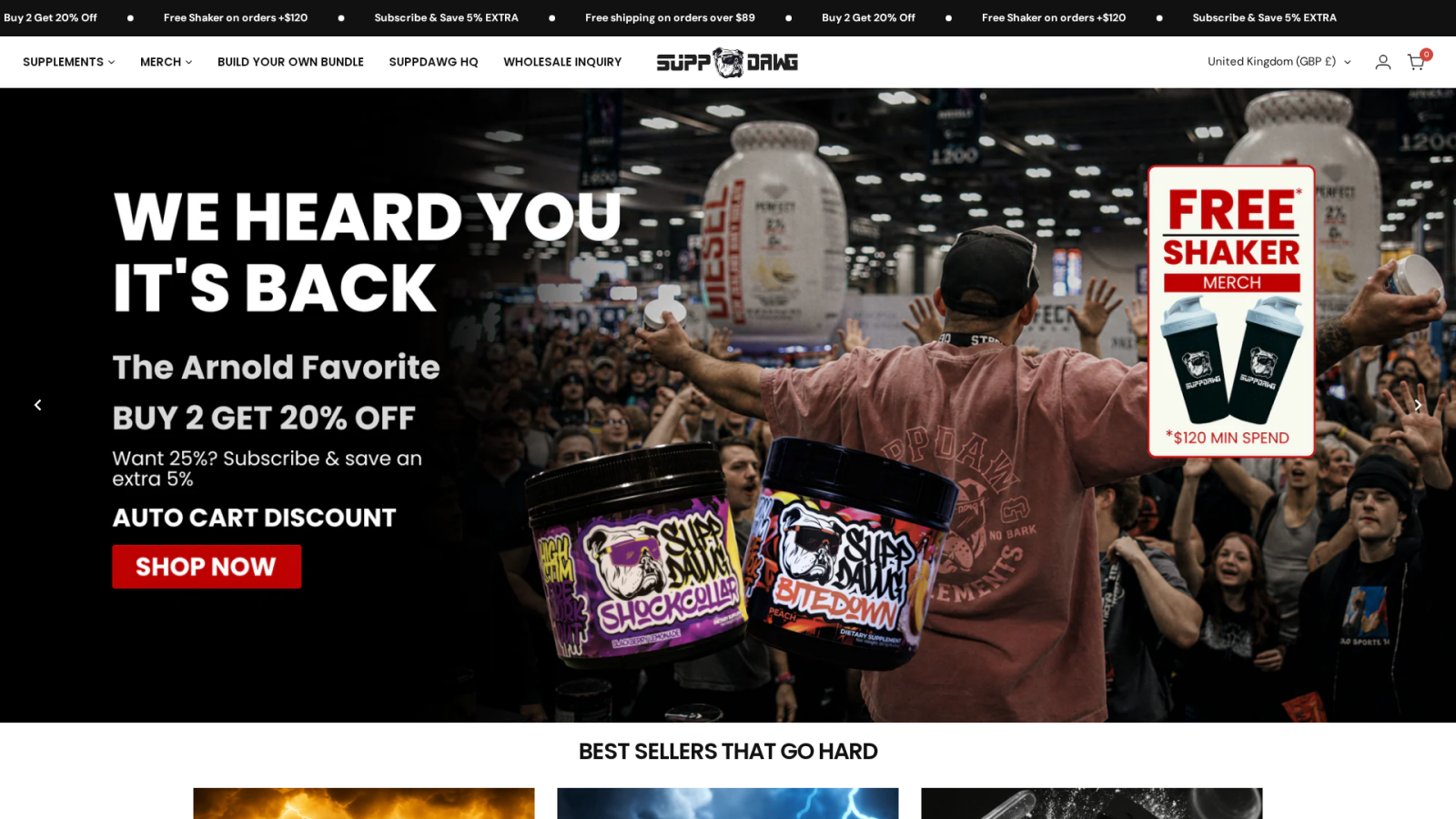
At SuppDawg Supplements, the formula philosophy is straightforward: fully disclosed ingredients, no proprietary blends, and doses that match the job. As founder, I built these products because I was tired of labels that looked impressive but told you nothing. Being a firefighter and competitive strength athlete means I need to know exactly what I am taking before a training session, not guess.
Shock Collar: for lifters who want high stim plus a fully disclosed 6 g L-citrulline dose
Shock Collar is SuppDawg's high-stimulant pre-workout. According to official brand content, it includes a fully disclosed 6 g L-citrulline dose, which means the number on the label is the actual citrulline you are getting. No ratio math. No hidden blend. It is built for lifters who want energy, focus, and pump support in a single high-performance formula.
If you train in the morning or early afternoon and can handle a high-stim formula, Shock Collar is built for that environment.
Bite Down: for evening training or stim-free pump sessions
Not every training session happens at 6 a.m. Bite Down non-stim pre-workout is designed for lifters who want pump and endurance support without caffeine or stimulants. It fits evening training sessions, second-shift schedules, and anyone who wants a serious pump formula without the risk of a caffeine-driven crash or disrupted sleep.
If you train late or have a high sensitivity to stimulants, the stim-free route is not a compromise. It is the smarter call.
When SuppDawg is not the right fit
Honesty matters here. Shock Collar is a high-stim formula. If you have a low caffeine tolerance, a heart condition, or are sensitive to stimulants, it may be too aggressive. Check the SuppDawg FAQ for guidance if you are unsure.
Some lifters also want pure single-ingredient citrulline control, meaning they want to dial in the exact citrulline dose independent of any other formula. In that case, a standalone citrulline powder gives more dosing flexibility than any pre-workout blend. Full pre-workout formulas are not the right tool for every situation, and being clear about that is part of building trust.
If you want to explore the full range of what is available, browse the SuppDawg supplements collection to see current products and decide what fits your training schedule.
FAQs about L-citrulline vs citrulline malate
Is L-citrulline better than citrulline malate for pumps? For pure pump support, L-citrulline is usually the cleaner choice. The dose on the label reflects actual citrulline with no ratio adjustment needed. Citrulline malate can work for pumps too, but only when the ratio is disclosed and the total dose is high enough.
Is 6 g of citrulline malate the same as 6 g of L-citrulline? No. At a 2:1 ratio, 6 g of citrulline malate yields roughly 4 g of actual citrulline. The rest is malic acid. If the ratio is not disclosed, you cannot calculate the real citrulline content at all.
How much citrulline should you take before a workout? Research commonly uses doses in the 6 to 8 g range for citrulline malate and around 6 g for pure L-citrulline. These are reference points from studies, not universal prescriptions. Check with a healthcare professional if you have any medical concerns.
When should you take citrulline pre-workout? Most research uses a 30 to 60 minute pre-training window. Taking it roughly 30 to 45 minutes before training is the practical standard for most pre-workout formulas.
Does citrulline malate help with endurance more than pumps? It can support both. Malic acid plays a role in energy metabolism, which is why citrulline malate appears in endurance-oriented formulas. For pure pump emphasis, though, pure L-citrulline is usually the more direct choice.
What if a pre-workout label does not list the citrulline malate ratio? Treat the active citrulline content as unknown. Do not assume 2:1. Look for a brand that fully discloses both the citrulline and malate portions separately or provides a clear ratio on the label.
Can you use citrulline with a stim-free pre-workout? Yes. Citrulline works independently of stimulants. Stim-free pump pre-workouts can and often do include L-citrulline or citrulline malate as a primary ingredient. Just confirm the dose is in a meaningful range.
Does more citrulline always mean better pumps? Not automatically. Dose matters, but so does the full formula context, your hydration, training intensity, and overall blood flow response. More citrulline than a useful dose does not add proportionally more benefit.
What other ingredients support a pump besides citrulline? Glycerol, Nitrosigine, agmatine, and betaine appear in pump-oriented formulas. Each works through a different mechanism. A well-formulated pump pre-workout often stacks more than one of these alongside citrulline.
Should beginners choose L-citrulline or citrulline malate? L-citrulline is the simpler starting point for beginners. The dosing is easier to read and evaluate. If a formula uses citrulline malate, check that the ratio is disclosed before buying.
How to choose the right one for your next pre-workout
For most pump-focused shoppers, pure L-citrulline is the easier and more transparent choice. The label tells you what you are getting. Citrulline malate has a legitimate role in endurance-oriented formulas, but only when the ratio is on the label and the dose is high enough to deliver meaningful citrulline.
Use this three-step framework before your next purchase:
- Check the actual citrulline yield. If the label says citrulline malate, find the ratio and calculate the real citrulline content before comparing gram weights.
- Check the full formula against your training schedule. High stim or stim-free. Morning or evening. Your training window matters as much as the ingredient form.
- Choose fully disclosed formulas. If a brand is hiding doses inside a proprietary blend, you have no way to evaluate whether the product can do what it claims.
If you want a fully disclosed stim-free pump option, see Bite Down non-stim pre-workout. If you want to compare the full SuppDawg lineup against your training goals, browse the SuppDawg supplements collection. All Bite. No Bark.
Supplement information is provided for educational purposes. Review the product label, directions and warnings, and consult a qualified healthcare professional before use when appropriate. These statements have not been evaluated by the Food and Drug Administration. This information is not intended to diagnose, treat, cure or prevent any disease.
About the author
Christopher Northern — Christopher Northern is the founder of SuppDawg, a career firefighter/paramedic and strength-sport competitor. He writes from firsthand experience with shift work, training, and transparent supplement labels.
How this guide was prepared
This guide was reviewed against current product labels and publicly available educational sources. It is intended for general education, not diagnosis or treatment, and was last updated August 8, 2026.
Best Appetite Suppressant Supplements for Cutting and What Actually Belongs on the Label
Best Nitric Oxide Supplements for Pumps What Lifters Should Compare
Related Posts

Agmatine vs Citrulline in Pre-Workout

Agmatine Sulfate vs L-Arginine: Reading the Bite Down Label

Best Non-Stim Pre-Workout for Pumps: A Practical Buyer’s Guide
