

How Much Caffeine Is Too Much Before Training
Caffeine is the most studied performance compound in sports nutrition. Used correctly, it sharpens focus, delays fatigue, and adds real output to your training. Push past your limit, though, and you are not getting a better workout - you are getting anxiety, a wrecked heart rate, and a crash that kills your next session too.
Why Caffeine Works in the First Place
Caffeine blocks adenosine receptors in the brain - the same receptors responsible for making you feel tired. Block adenosine, and your central nervous system (CNS) gets a hard jolt of wakefulness, dopamine activity climbs, and you feel ready to train hard. The result is measurable: improved power output, faster reaction time, better muscular endurance, and reduced perceived effort during heavy compound work.
The International Society of Sports Nutrition (ISSN) classifies caffeine as one of the most effective ergogenic aids available, with the strongest performance benefits appearing at a dose of 3 to 6 mg per kilogram of bodyweight taken 30 to 60 minutes before training. For a 185 lb (84 kg) lifter, that puts the sweet spot roughly between 250 mg and 500 mg - a range that already overlaps with the upper safety boundary.
At SuppDawg Supplements, the pre-workout lineup is built around understanding that range and not accidentally wrecking it.
The Hard Line: Where Caffeine Becomes Too Much
The FDA's 400 mg Daily Ceiling
The U.S. Food and Drug Administration sets 400 mg as the upper daily limit for healthy adults. That is the total across everything: coffee, energy drinks, pre-workout, intra-workout, and afternoon espresso shots. The moment you start stacking sources without tracking them, crossing 400 mg becomes easy and fast.
Here is what that looks like across a typical lifter's day:
| Source | Typical Caffeine |
|---|---|
| Morning coffee (2 cups) | ~190 mg |
| Standard pre-workout | ~200-300 mg |
| Energy drink (afternoon) | ~80-200 mg |
| Total (potential) | ~470-690 mg |
That table is not hypothetical. It is the actual intake pattern of a lot of gym-goers who are wondering why they feel wired, anxious, or unable to sleep.
What Happens When You Go Over
Exceeding your personal threshold - which is not always exactly 400 mg - produces a predictable cascade of problems:
- Jitters and overstimulation: The CNS gets flooded, motor control degrades, and you shake through your working sets.
- Elevated heart rate and blood pressure: At high doses, caffeine spikes cardiovascular markers well above training-normal levels. For anyone with an underlying heart condition, this is not a minor concern.
- GI distress: High-dose caffeine accelerates gut motility. That is a polite way of saying your stomach may not cooperate mid-session.
- Anxiety and mental fog: Counterintuitively, too much caffeine produces the exact opposite of sharp focus - racing thoughts, poor concentration, and an inability to get into the zone.
- The crash: What goes up fast, comes down hard. A massive caffeine spike followed by a sharp drop destroys the back half of your workout and the hours after it.
In extreme cases - intake above 1,000 mg paired with intense physical exertion - there is a documented risk of rhabdomyolysis, a serious condition involving muscle breakdown and potential kidney damage. That is the outer edge of the danger zone, but it is real.
High Stim Pre Workout: Powerful Tool or Easy Trap?
A high stim pre workout typically carries 300 mg to 400 mg of caffeine per serving, sometimes stacking additional stimulants like caffeine anhydrous, di-caffeine malate, or TeaCrine on top. These formulas are built for experienced lifters who have already developed a meaningful tolerance to lower doses and need a stronger signal to feel the same output.
Used correctly, a high caffeine pre workout genuinely works. Research from the ISSN supports doses toward the upper end of the 3 to 6 mg/kg range for maximal strength and endurance performance. A 200 lb (91 kg) experienced powerlifter could theoretically land at 545 mg at that ceiling - so a 350 to 400 mg pre-workout is not automatically reckless for that athlete in isolation.
The trap is context. If that same athlete had two cups of coffee before the gym, they are already at 500 to 600 mg before touching their pre-workout. That is where the wheels come off.
Signs a high stim pre workout is working against you:
- Visible shaking during warm-up sets
- Heart rate feels out of proportion to effort
- You feel anxious or irritable rather than dialed in
- Sleep quality is consistently poor regardless of when you train
- The same dose that used to hit hard now barely registers (tolerance creep)
Tolerance creep is one of the more insidious problems with high caffeine pre workout use. The body adapts by upregulating adenosine receptors, which means you need more caffeine to get the same effect. If you find yourself asking why your pre-workout isn't working anymore, this is the most likely answer - and there is a practical stimulant reset protocol worth running before you increase your dose further.
Finding Your Personal Caffeine Ceiling
The research-based dose range of 3 to 6 mg/kg is a useful starting point, but individual variation matters. Genetics, body composition, habitual caffeine intake, sleep status, and stress all affect how any given dose lands. Two lifters of the same bodyweight can react completely differently to identical pre-workout servings.
A practical approach:
- Calculate your bodyweight-based range. Multiply your weight in kg by 3 for a conservative starting point and by 6 for the upper end.
- Account for all caffeine sources that day, not just your pre-workout.
- Start at the lower end of any new formula. Half a scoop of a high stim product before committing to a full dose is a legitimate strategy, not a weakness.
- Track your response across 3 to 5 sessions. Jitters, heart rate, sleep impact, and actual training performance are the relevant signals.
- Build in low or no-caffeine days. This is the most underrated tool for keeping caffeine sensitivity intact without needing a full reset.
The salt and electrolyte profile inside your pre-workout also affects how stimulants land - hydration status is directly tied to how your CNS handles the caffeine load.
When to Switch to Non-Stim
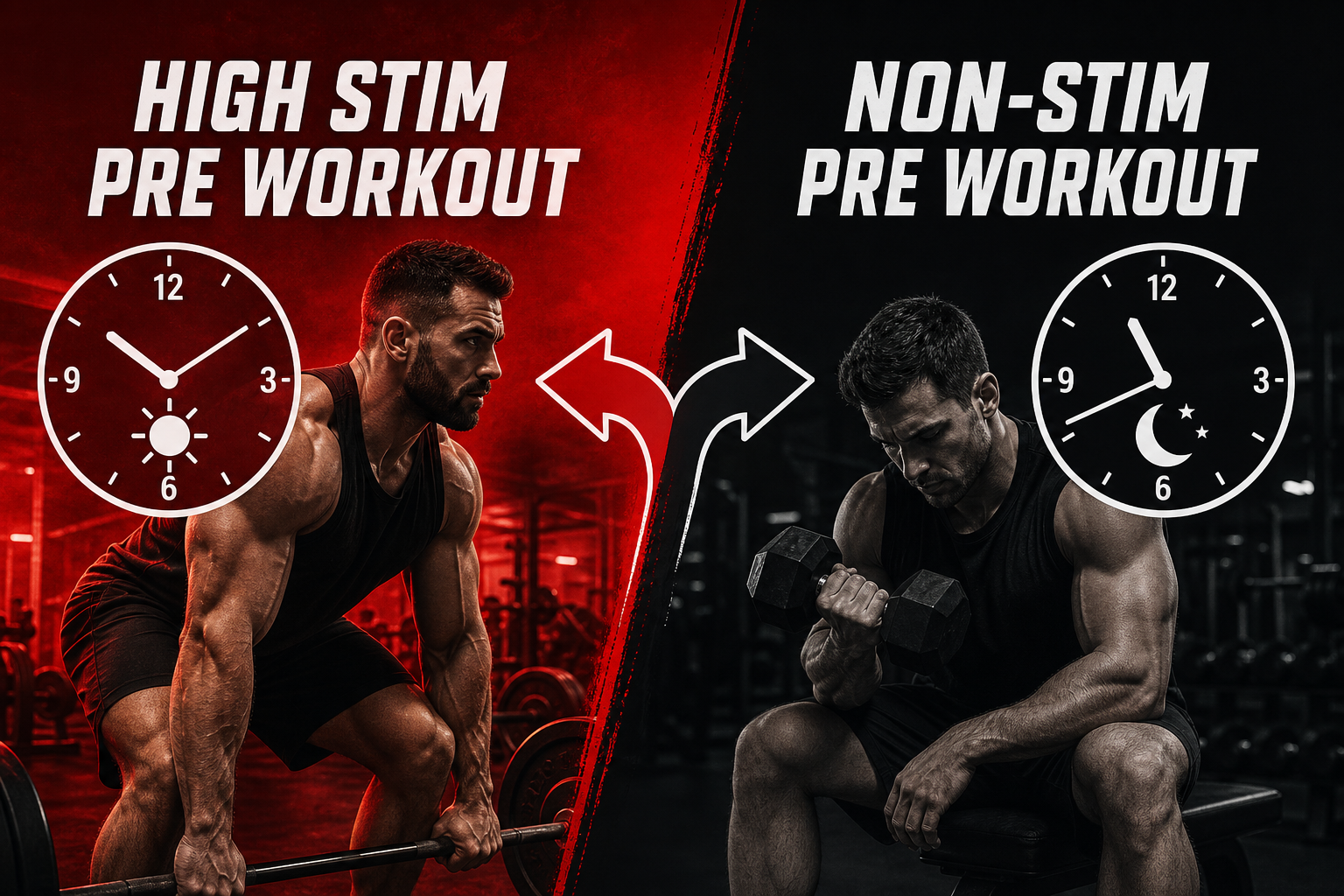
Not every training situation calls for a high caffeine pre workout. There are specific scenarios where going non stim pre workout is the smarter call:
- Evening training sessions. Caffeine has a half-life of approximately 5 hours. A 400 mg dose at 7 PM means roughly 200 mg is still circulating at midnight. That is a direct attack on sleep quality, and sleep is where muscle growth actually happens.
- During a stimulant reset. If tolerance has built to the point where even high-dose products are not delivering, running a week on a non-stim formula while reducing habitual caffeine use is the move.
- If you are already caffeinated. Heavy coffee drinkers who have already hit 300 mg before training should seriously consider whether adding another 300 to 400 mg is productive or just adding noise.
- High-stress periods. Cortisol and caffeine both activate the sympathetic nervous system. Stacking them during already-elevated stress states often produces diminishing training returns and amplified side effects.
Caffeine Timing Matters as Much as Dose
Caffeine reaches peak plasma concentration roughly 30 to 90 minutes after ingestion. For most pre-workout formulas, dosing 30 to 45 minutes before training puts peak stimulation right at the start of your working sets. Timing matters more than most lifters account for - taking your pre-workout immediately before you start warming up means you are burning through energy during warm-ups and potentially fading mid-session.
Late dosing also compounds the sleep disruption problem. Given caffeine's half-life, avoiding high-dose caffeine after 2 PM is a reasonable rule for most people training in the evening. If your schedule forces late sessions, a non-stim formula stacked with ingredients like citrulline malate and beta-alanine can deliver real performance output without the sleep cost.
Caffeine and Recovery: The Hidden Cost of Going Too Hard
Recovery is where gains are actually built, and caffeine-driven sleep disruption quietly erodes it. A 2024 review published in the Journal of the International Society of Sports Nutrition reinforced that caffeine use timing and dose directly affect sleep architecture, with higher doses and later timing producing the most significant disruptions to deep and REM sleep stages.
The irony is real: using too much caffeine before training in the name of better performance degrades the sleep that makes training adaptations stick. You are essentially borrowing energy from your recovery account and paying interest on it every night.
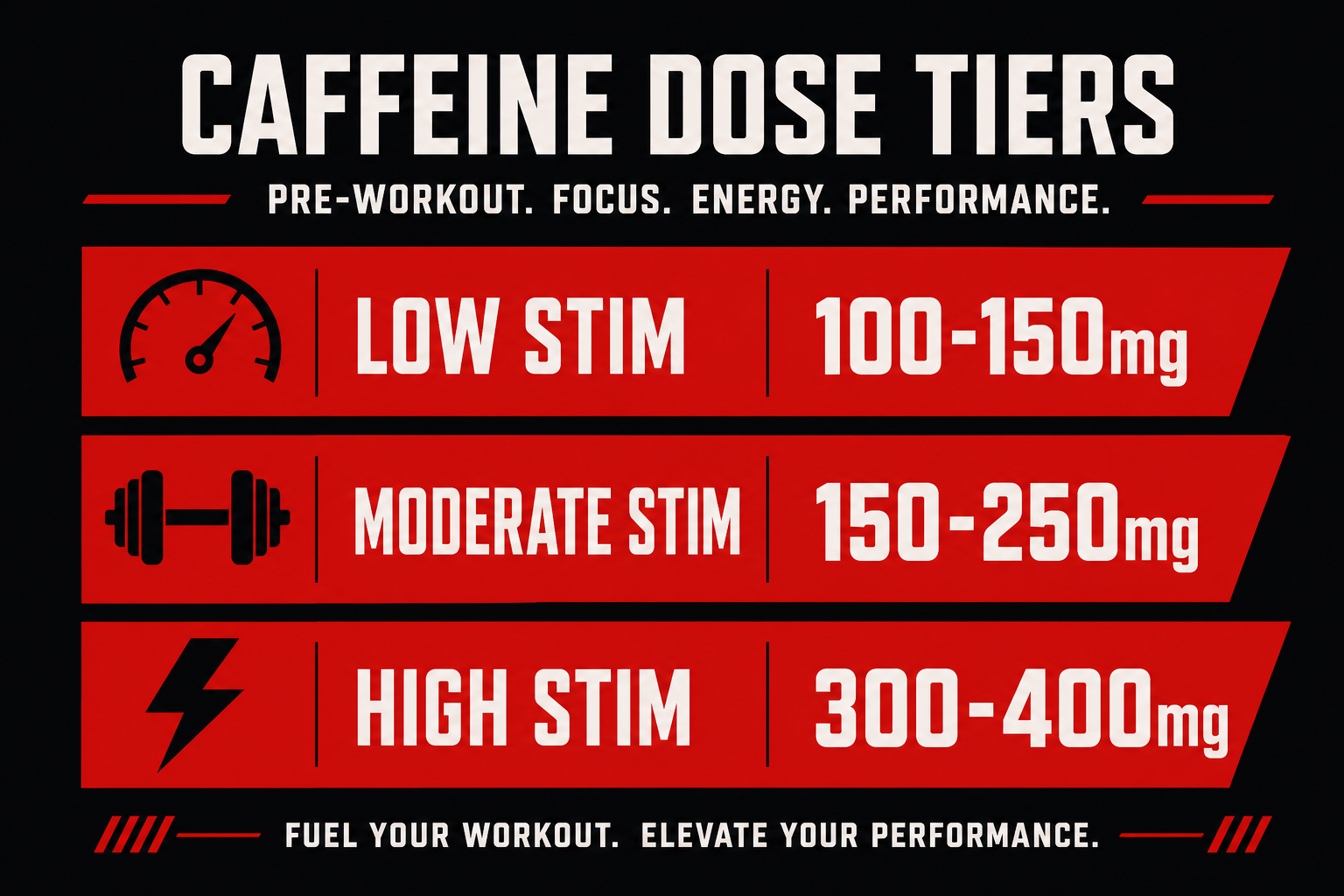
Quick Reference: Caffeine Dose Tiers for Training
| Tier | Dose Range | Best For |
|---|---|---|
| Low Stim | 100-150 mg | Beginners, caffeine-sensitive lifters, evening sessions |
| Moderate Stim | 150-250 mg | Most recreational lifters, daily training |
| High Stim | 300-400 mg | Experienced lifters with established tolerance, non-consecutive use |
| Over the Line | 400+ mg (pre-workout alone) | Not recommended without full daily accounting |
FAQ
Is 400 mg of caffeine before a workout safe? For most healthy adults, 400 mg is the FDA's daily upper limit. That amount in a single pre-workout serving leaves zero room for other caffeine sources throughout the day.
How long does caffeine stay in your system after a pre-workout? Caffeine has a half-life of roughly 5 hours, meaning a 300 mg dose still has about 150 mg active in your bloodstream 5 hours later.
Can you build a tolerance to pre-workout caffeine? Yes. Regular high-dose use causes adenosine receptor upregulation, reducing caffeine's effect over time. Periodic low-caffeine or no-caffeine days slow this process significantly.
What are the signs you have had too much caffeine before training? Jitters, racing heart, anxiety, GI discomfort, and inability to focus during sets are the most common signs you have crossed your personal threshold.
Is a non-stim pre-workout effective for building muscle and strength? Absolutely. Non-stim formulas with clinical doses of citrulline, beta-alanine, and creatine support performance and pump without any caffeine, making them ideal for evening training or stimulant resets.
The Bottom Line
How much caffeine is too much before training is not a fixed number - it depends on your bodyweight, tolerance, total daily intake, and training timing. The research-backed performance window is 3 to 6 mg per kg of bodyweight, with 400 mg as the hard ceiling for daily total consumption. High stim pre workout formulas are a legitimate tool for experienced athletes, but only when used with full awareness of cumulative caffeine load and recovery cost. Know your sources, track your total intake, and give your CNS time to reset. More caffeine is not always more output - sometimes the smarter dose is the one that actually lets you sleep and come back stronger tomorrow.

Keep exploring Pre-Workout
Build on this guide with practical next steps:
- the complete pre-workout guide
- high-stim vs non-stim pre-workout
- high-stim and stimulant-free pre-workouts
Supplement information is provided for educational purposes. Review the product label, directions and warnings, and consult a qualified healthcare professional before use when appropriate. These statements have not been evaluated by the Food and Drug Administration. This information is not intended to diagnose, treat, cure or prevent any disease.
About the author
Christopher Northern — Christopher Northern is the founder of SuppDawg, a career firefighter/paramedic and strength-sport competitor. He writes from firsthand experience with shift work, training, and transparent supplement labels.
How this guide was prepared
This guide was reviewed against current product labels and publicly available educational sources. It is intended for general education, not diagnosis or treatment, and was last updated August 8, 2026.
Best High-Stim Pre-Workout: How to Compare Formulas
Best Non-Stim Pre-Workout for Pumps: A Practical Buyer’s Guide
Related Posts

How to Read a Supplement Certificate of Analysis

Creatine Capsules vs Powder: Dose, Cost and Convenience

Pre-Workout for Drug-Tested Powerlifting: Checks Before Buying

Pre-Workout vs Carbs for Long Lifting Sessions

Can You Mix Pre-Workout the Night Before?

Pre-Workout Without Beta-Alanine or Creatine: Bite Down

L-Theanine and Caffeine in Pre-Workout: What Changes?
