

When to Take Creatine for a Consistent Routine
Creatine timing is one of the most searched questions in sports nutrition, and the answer is simpler than most people expect. Consistency beats perfect timing every single time, but knowing when and how to fit creatine monohydrate into your daily routine can sharpen your results at the margins.
What Creatine Actually Does Inside Your Muscles
Before talking timing, you need to understand the mechanism. Creatine monohydrate is one of the most researched ergogenic aids in sports science, with decades of controlled research backing its safety and performance benefits.
When you supplement with creatine, your muscles store it as phosphocreatine (PCr). During high-intensity efforts, such as a max squat, a heavy deadlift, or a loaded carry, your body burns through adenosine triphosphate (ATP) fast. PCr rapidly regenerates that ATP so your muscles keep firing when they need it most.
The result is more reps, heavier loads, and better power output over time. A 2024 systematic review and meta-analysis published in Nutrients confirmed that creatine supplementation combined with resistance training produces significantly greater gains in both upper- and lower-body strength compared to placebo plus training alone.
The key phrase is "over time." Creatine builds up in muscle tissue across days and weeks of consistent use. It is not a one-shot stimulant. That distinction matters when figuring out where it fits in your stack.
The Real Answer to When Should You Take Creatine
Here is the honest answer: take it close to your training window, but do not overthink it.
A 2013 randomized clinical trial compared taking five grams of creatine immediately before versus immediately after resistance training sessions. The post-workout group showed slightly greater improvements in fat-free mass and strength after four weeks. However, the margin was small, and follow-up studies including a 2022 study published in Frontiers in Sports and Active Living involving collegiate athletes found no statistically significant difference between pre- and post-workout creatine timing on muscle thickness, strength, or body composition.
What the research consistently agrees on: taking creatine close to your training session, whether before or after, appears modestly superior to taking it at random times of day. Post-workout gets a slight nod from some studies because your muscles are primed to absorb nutrients after training, especially when paired with carbohydrates and protein. But if the morning with breakfast or pre-workout in your shaker is what actually happens every day, that beats a perfect post-workout dose you forget half the time.
The non-negotiable rule: daily consistency at any predictable time is more important than exact timing.
Workout Days vs. Rest Days
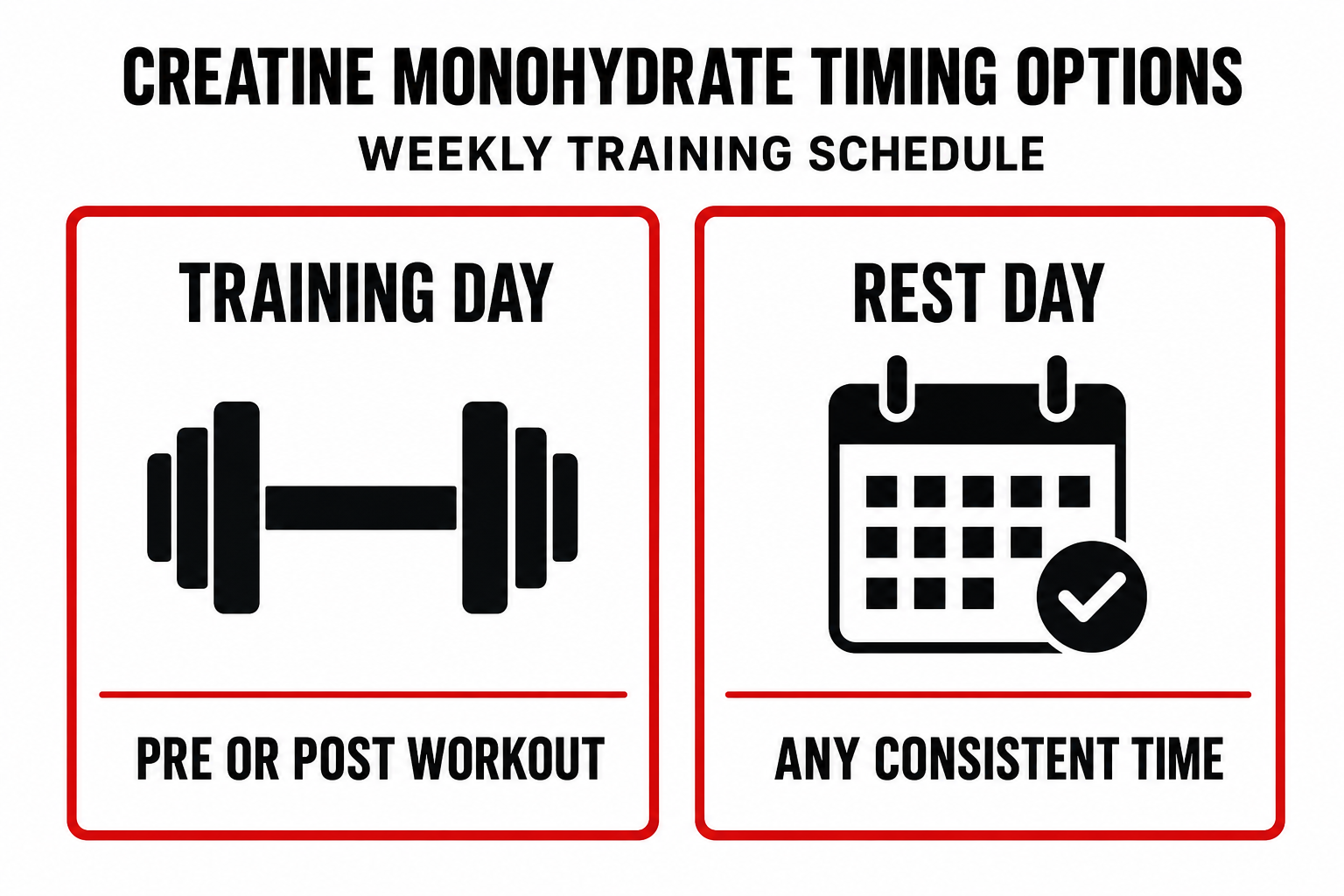
On training days, take your creatine within an hour before or after your session when possible.
On rest days, take it at any consistent time. Morning with breakfast works well. The goal on rest days is simply to maintain elevated muscle creatine stores, not to chase a training-adjacent window.
| Timing Scenario | Practical Recommendation |
|---|---|
| Training day, pre-session | Take 3-5g within 60 min before lifting |
| Training day, post-session | Take 3-5g within 60 min after lifting |
| Rest day, morning | Take 3-5g with breakfast or a meal |
| Rest day, any time | Any consistent daily time works fine |
How Much Creatine Should You Take
The standard effective dose is 3 to 5 grams per day of creatine monohydrate. No loading phase is required to see results. Research on collegiate athletes showed that 5 grams per day across a 10-week resistance training program produced significant increases in bench press, squat, and power clean performance without any loading protocol.
If you want to saturate muscle stores faster, a loading phase of approximately 20 grams per day split into four doses across 5 to 7 days will get you there quicker. After loading, drop back to 3 to 5 grams daily to maintain those elevated stores. Either route works. The loading phase just gets you to full saturation about 3 weeks faster.
Hydration matters here. Creatine draws water into muscle cells, which is part of how it supports cell volume and performance. Drink enough water throughout the day, especially on heavy training days.
Creatine vs Pre Workout: Two Different Jobs
A lot of lifters conflate these two, so let's be direct. Creatine vs pre workout is not a competition. They do completely different things.
| Creatine Monohydrate | Pre-Workout | |
|---|---|---|
| Primary mechanism | Increases muscle PCr stores, regenerates ATP | Stimulates CNS via caffeine, drives nitric oxide production |
| When it kicks in | Weeks of consistent daily use | 20 to 45 minutes after dosing |
| Best for | Long-term strength, power, recovery | Acute energy, focus, performance that session |
| Take it | Daily, training or rest days | Training days only, pre-session |
| Without the other | Still effective | Still effective |
Creatine is a long game. Pre-workout is acute ignition. One builds your capacity over weeks. The other lights you up right now. Using both together is one of the most practical stacks in strength training.
If you are already running a high-stim pre-workout and wondering whether to add creatine separately, the answer is almost always yes. Some pre-workout formulas include creatine, but the dose is often too low to hit the therapeutic 3 to 5 gram daily target. Check your label and top off with a standalone creatine product when needed.
Can Caffeine Interfere With Creatine
This question comes up constantly. Early research raised the concern that caffeine might blunt creatine's benefits, but a comprehensive review found no consistent evidence that caffeine impairs creatine uptake or its performance effects at standard doses. If your pre-workout carries heavy stimulant volume, the smarter move is to take your creatine post-workout separately. That sidesteps any theoretical interference and times your creatine with the post-training absorption window anyway.
For those running a non-stim pre-workout like Bite Down on pump-focused days, stacking creatine directly into your pre-session drink is completely clean and straightforward.
How Buff Dawg Fits Into Your Daily Stack
SuppDawg Supplements built Buff Dawg as a daily creatine formula designed around exactly what serious lifters need: a transparent, fully disclosed dose of creatine monohydrate with no proprietary blends, no underdosed fillers, and no guesswork. Built by athletes for athletes, with the same first-responder standard of transparency that runs through every SuppDawg product.
You know exactly what you are putting in your body and exactly how much. That is the foundation of a stack you can actually trust.
For lifters running Shock Collar on high-output training days, Buff Dawg can be taken post-workout to time with the recovery window. On lower-intensity days or sessions where you reach for Bite Down, Buff Dawg stacks cleanly pre- or post-session. The point is building the daily habit, not stressing over a 30-minute window.
Common Creatine Mistakes to Avoid
Most people do not fail because of bad timing. They fail because of these habits:
- Skipping rest-day doses. Creatine works through accumulation. Missing doses on rest days chips away at your muscle saturation levels. Take it every single day.
- Expecting overnight results. Give creatine at least two to four weeks of daily use before judging its effect. The gains are real, but they are not instant.
- Relying on underdosed pre-workout creatine. Many pre-workout formulas add 1 to 2 grams of creatine as a label claim. That is not enough. Run a dedicated daily creatine product alongside your pre-workout.
- Ignoring water intake. Creatine pulls water into muscle cells. Short-changing your hydration means short-changing your results.
- Stressing over perfect timing. A consistent dose at any predictable time beats sporadic perfect timing every week.
FAQ
Is it better to take creatine before or after a workout? Post-workout has a slight edge in some studies, but the difference is small. Consistency and daily dosing matter far more than precise timing.
Can I take creatine every day, even on rest days? Yes. Daily dosing maintains elevated muscle creatine stores. Skipping rest days reduces saturation and slows results.
Do I need to load creatine, or can I just take 5g daily? A loading phase gets you to saturation faster, but 3 to 5 grams daily without loading reaches the same endpoint in about three to four weeks. Both approaches work.
Can I mix creatine into my pre-workout drink? Yes, especially if your pre-workout is stimulant-free or low-caffeine. If your pre-workout is high-stim, taking creatine post-workout separately is a clean approach.
How long before I notice creatine working? Most lifters notice improved performance and fuller muscles within two to four weeks of consistent daily dosing at 3 to 5 grams per day.
Built for the grind. No proprietary blends, no gimmicks, no bark. Just the work and the fuel to back it up.
Read More: Best High Stimulant Pre-Workout: Why Most Brands Fail the First Responder Test
Supplement information is provided for educational purposes. Review the product label, directions and warnings, and consult a qualified healthcare professional before use when appropriate. These statements have not been evaluated by the Food and Drug Administration. This information is not intended to diagnose, treat, cure or prevent any disease.
About the author
Christopher Northern — Christopher Northern is the founder of SuppDawg, a career firefighter/paramedic and strength-sport competitor. He writes from firsthand experience with shift work, training, and transparent supplement labels.
How this guide was prepared
This guide was reviewed against current product labels and publicly available educational sources. It is intended for general education, not diagnosis or treatment, and was last updated August 8, 2026.
The Real Guide to Choosing a Melatonin Free Sleep Aid for Athletes
Creatine Monohydrate vs Creatine HCL What Buyers Compare First
Related Posts

Best Pre-Workout Without Beta-Alanine: What to Look For

Best Pre-Workout Stack: How to Combine Pre-Workout and Creatine

Nitrosigine vs. L-Citrulline: What Each Does in Pre-Workout

Firefighter Stair-Climb Training: Heat, Hydration and Supplement Considerations

Best Pre-Workout for Strongman: Training and Competition-Day Guide

Supplements for Powerlifters A Practical Guide to Strength Energy and Recovery

Pre-Workout Pills vs Powder Which Format Is Better for Your Training
