

Creatine vs Pre-Workout: Do You Need Both?
These two supplements dominate every gym bag and supplement shelf, yet most people have no clear idea what separates them. Creatine builds real, lasting strength. Pre-workout gives you the energy to attack today's session. They solve different problems on different timescales, and understanding that distinction is the difference between a smart supplement stack and wasted money.
What Creatine Actually Does (And Why It Works)
Creatine is not a stimulant. It does not hit you in 20 minutes or make your skin tingle. What creatine monohydrate does is quietly fill your muscles with phosphocreatine, the molecule your body uses to rapidly regenerate ATP during short, explosive efforts like a heavy squat set or a max-effort deadlift.
Your body naturally produces around 1 to 2 grams of creatine per day, mostly in the liver and kidneys. That baseline is rarely enough to saturate your muscle stores fully. Supplementing with 3 to 5 grams daily closes that gap and keeps your phosphocreatine system running at full capacity.
The result shows up over weeks, not hours. Research across 143 controlled trials confirms creatine supplementation adds meaningful lean mass in athletes who train consistently. A 2024 meta-analysis (Bonilla et al.) found that creatine added approximately 0.82 kg of fat-free mass across a broad population, with resistance-trained athletes seeing even stronger results. That is not a small number when you are chasing a PR.
Beyond raw size, creatine supports recovery. Studies show it can reduce muscle damage markers after intense training, meaning you can come back harder, sooner. For powerlifters, strongman competitors, first responders doing functional fitness, or any athlete grinding through high-volume training blocks, that recovery edge compounds over a full training cycle.
Key creatine benefits at a glance:
- Increases phosphocreatine stores for faster ATP regeneration
- Supports strength and power output over time
- Improves recovery between heavy sessions
- Well-documented cognitive benefits under fatigue and sleep deprivation
- Safe, affordable, and the most researched supplement in sports nutrition
What Pre-Workout Actually Does
Pre-workout is built for right now. It is a short-term performance tool, not a long-term builder. The core job of a quality pre-workout formula is to boost energy, sharpen mental focus, and increase blood flow so your training session is more productive.
The primary driver is caffeine. A solid dose of caffeine improves alertness, reduces perceived effort, and provides a modest but real acute boost to strength and endurance. Ingredients like citrulline malate drive nitric oxide production for better blood flow and pumps. Beta-alanine buffers acid buildup in your muscles to push your threshold for high-rep sets further. These effects are session-specific: they show up during the workout and taper off afterward.
There are two main categories worth knowing:
| Type | Best For | Key Ingredients |
|---|---|---|
| High-stim pre-workout | Maximum energy, intense focus, long training sessions | High-dose caffeine, tyrosine, alpha-GPC, beta-alanine |
| Non-stim pre-workout | Pumps, endurance, evening training, stim-sensitive athletes | Citrulline, agmatine, betaine, nitrates |
SuppDawg Supplements built both options around transparent, fully disclosed formulas. Shock Collar is the high-stim option for athletes who need maximum energy and focus. Bite Down is the caffeine-free pump formula designed for evening lifters, stim-sensitive athletes, or anyone who wants performance without the crash. No proprietary blends. No underdosed garbage. Built by athletes, for athletes.
Creatine vs Pre Workout: The Core Difference
Here is the straight answer most articles dance around: creatine and pre-workout do not compete with each other. They operate on completely different timescales and target different performance mechanisms.
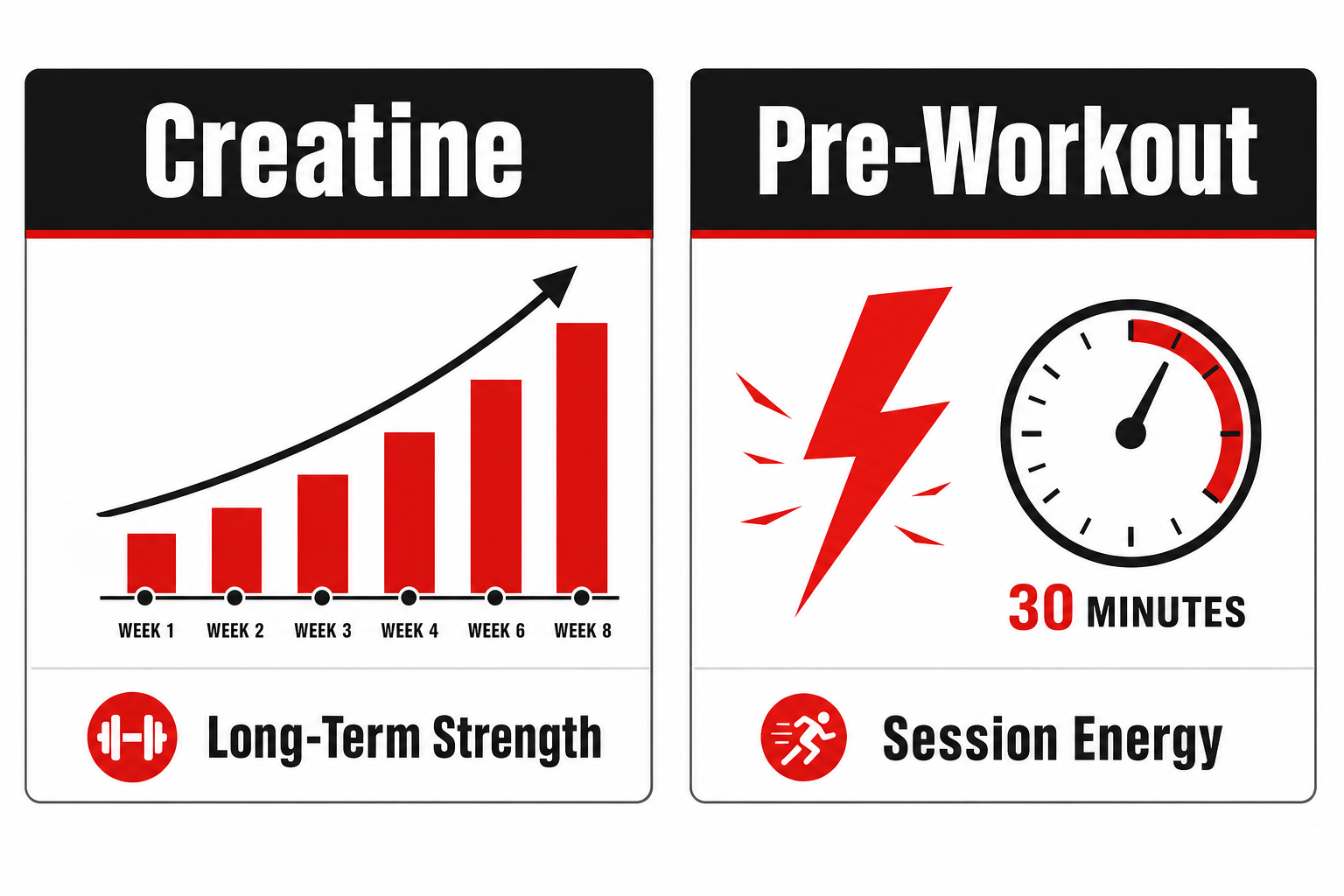
Creatine is a chronic supplement. Its benefits accumulate over weeks of consistent daily use by saturating your muscle creatine stores. You take it every day, whether or not you train. Pre-workout is an acute supplement. You take it 20 to 30 minutes before training specifically to enhance that session's energy, focus, and blood flow.
Confusing the two is like comparing a training program to a cup of coffee. One builds your capacity. The other helps you show up ready to use it.
If you are forced to choose just one, creatine monohydrate has the deeper evidence base and produces changes that stay with you. A pre-workout's benefit ends when the caffeine metabolizes. But for serious athletes, the real answer is that you do not have to choose.
Can You Take Creatine and Pre-Workout Together?
Yes, and for most serious athletes, doing both is the smartest play. There was an older concern that caffeine might interfere with creatine uptake, but a comprehensive review of the available evidence found no consistent support for that claim. Caffeine does not meaningfully blunt creatine's performance benefits when both are used at appropriate doses.
The practical approach is simple: take your pre-workout 20 to 30 minutes before training for the energy and focus benefits. Take creatine daily at a consistent time, either with your post-workout meal or any other meal that makes it easy to stay consistent. Post-workout timing may offer a slight edge for body composition based on some research, but the most important factor is showing up with 3 to 5 grams every single day.
Check out the anatomy of a high-stim pre-workout if you want to understand what separates a quality formula from a weak one before you decide which pre-workout belongs in your stack.
When Should You Take Creatine: Timing Explained
When should you take creatine is one of the most searched questions in sports nutrition, and the honest answer is that timing matters less than consistency.
Your muscles accumulate creatine stores over days and weeks. Missing the 30-minute post-workout window by a few hours will not undo your progress. What will undo your progress is skipping days, cycling off unnecessarily, or under-dosing because you are chasing a bargain product.
Creatine timing guidelines that actually matter:
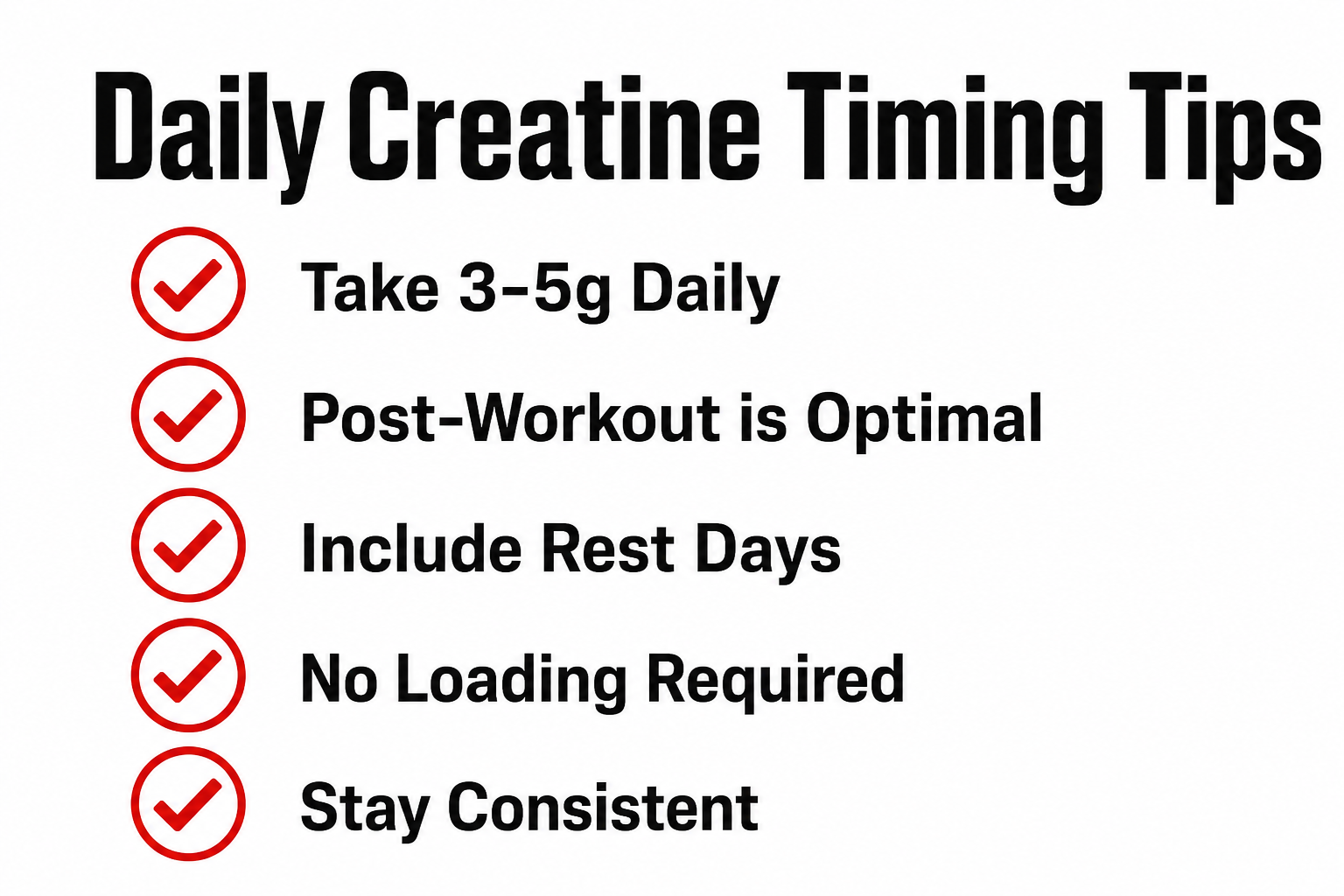
- Take 3 to 5 grams daily, every day, including rest days
- Post-workout with a carbohydrate and protein source appears slightly superior for body composition based on available research
- If you forget post-workout, take it with any meal; absorption is what counts
- A loading phase (20 g per day for 5 to 7 days) can saturate stores faster but is not required
- Creatine monohydrate is the most studied and best-validated form; do not pay a premium for exotic variants unless you have a specific reason
SuppDawg's Buff Dawg creatine formula is built on this principle: straightforward, fully disclosed, dosed to actually work. No fillers. No fluff. Just a clean daily creatine that does what the research says it should.
Creatine Monohydrate vs Other Forms
The supplement market loves to push newer forms of creatine as if creatine monohydrate has somehow become obsolete. It has not. Creatine monohydrate remains the most researched compound in sports nutrition, with the most robust safety and efficacy data available across 25 years of controlled trials.
Creatine HCl and other variants may absorb slightly better in smaller doses, and some athletes tolerate them better if they experience digestive issues with monohydrate. A 2025 randomized clinical trial comparing creatine monohydrate with creatine hydrochloride in elite team-sport athletes found both forms produced comparable improvements in strength and body composition at low dosages. For the vast majority of athletes, monohydrate at 3 to 5 grams per day is the most cost-effective and evidence-backed choice.
| Form | Evidence Base | Typical Dose | Notes |
|---|---|---| ---| | Creatine Monohydrate | Extremely high (25+ years, hundreds of RCTs) | 3 to 5 g/day | Best value, most research | | Creatine HCl | Moderate | 1 to 2 g/day | Better solubility, less bloating for some | | Buffered Creatine | Limited | 1.5 to 3 g/day | No clear advantage over monohydrate | | Creatine Ethyl Ester | Low | Varies | Not recommended; inferior bioavailability |
Bottom line: do not let marketing steer you toward a more expensive form without a good personal reason. Monohydrate is the standard for a reason.
Who Needs Pre-Workout, Who Needs Creatine, and Who Needs Both
This is a practical question and it deserves a practical answer.
Start with creatine if: You are focused on long-term strength, power output, and lean mass gains. You train consistently but your energy levels are already solid. You want the safest, most evidence-backed supplement investment with minimal complexity.
Start with pre-workout if: Your biggest problem is low energy, weak focus, or poor motivation heading into sessions. You need an immediate lift, not a long-term builder. Look for high-stim options if caffeine is your main tool, or a non-stim formula if you train late or are sensitive to stimulants.
Use both if: You are a serious lifter, competitor, or first responder who needs every edge available. Creatine builds the foundation. Pre-workout puts the fire under the session. Stacking them is not reckless; it is what athletes who want to perform at their best actually do.
SuppDawg Supplements was built by a firefighter, paramedic, and competitive strength athlete who understood exactly this kind of problem. The mission from day one has been transparent labels, effective doses, and formulas that reflect how hard athletes actually train. All Bite. No Bark.
FAQ
Can I take creatine and pre-workout at the same time? Yes. Caffeine does not meaningfully interfere with creatine absorption or effectiveness. Take pre-workout before training and creatine daily at any consistent time.
Does creatine count as a pre-workout supplement? No. Creatine works through daily muscle saturation over weeks. Pre-workout delivers acute energy and focus benefits within a single session. They are distinct products with different mechanisms.
What is the best time to take creatine for results? Consistency matters more than timing. Post-workout with food shows a slight body composition advantage in some studies, but taking it daily at any time is what drives results.
Will creatine make me bloated or hold water? Creatine increases intramuscular water retention, which is part of how it works. This is not the same as subcutaneous bloating. Most athletes notice fuller muscles, not puffiness.
Is creatine monohydrate better than creatine HCl? For most athletes, yes. Creatine monohydrate has the strongest evidence base and the best cost-to-effectiveness ratio. HCl may suit those with digestive sensitivity to monohydrate.
The Bottom Line
The creatine vs pre workout debate is really a false choice. These supplements are not competitors. Creatine monohydrate builds the engine over time through consistent daily use. Pre-workout loads the fuel for today's session. For serious athletes who want every available edge, both belong in the stack. Start with creatine because the evidence is undeniable. Add a quality pre-workout when your energy and focus need a structured boost. And if you want formulas built with transparent labels and no underdosed ingredients, SuppDawg Supplements has exactly what you need. Built for the grind. No shortcuts.
Supplement information is provided for educational purposes. Review the product label, directions and warnings, and consult a qualified healthcare professional before use when appropriate. These statements have not been evaluated by the Food and Drug Administration. This information is not intended to diagnose, treat, cure or prevent any disease.
About the author
Christopher Northern — Christopher Northern is the founder of SuppDawg, a career firefighter/paramedic and strength-sport competitor. He writes from firsthand experience with shift work, training, and transparent supplement labels.
How this guide was prepared
This guide was reviewed against current product labels and publicly available educational sources. It is intended for general education, not diagnosis or treatment, and was last updated August 8, 2026.
High-Stim vs Non-Stim Pre-Workout: Which One Should You Use?
Why You’re Not Losing Weight (Even When You’re Doing Everything Right)
Related Posts

Creatine vs Protein vs BCAAs: What Each Does and Which Comes First

Does Pre-Workout Expire or Clump? Storage and Replacement Guide

Can You Mix Stim and Non-Stim Pre-Workout? Read the Labels First

Supplement Facts Serving Size vs Scoop Weight

How to Compare Pre-Workout Cost Per Full Serving

How to Compare Natural Sleep Aid Ingredients and Labels

Melatonin Sleep Aids: Timing, Safety and Alternatives
